
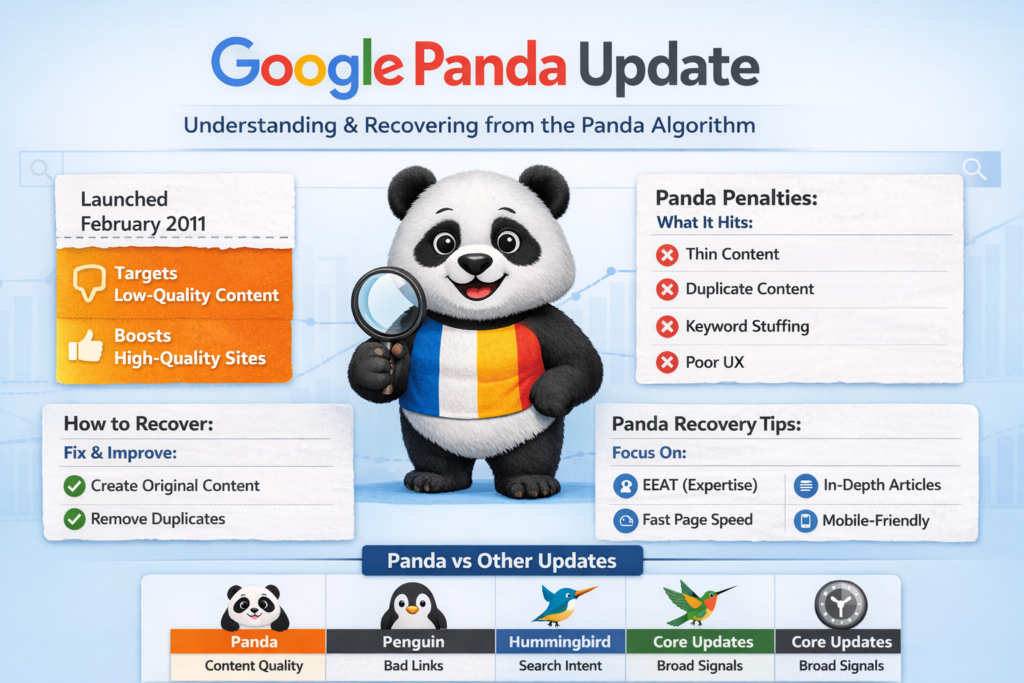
What is Google Panda Update?
The Google Panda Update was launched in February 2011 to improve search result quality by targeting low-quality and thin content websites.
Its primary goal was:
👉 Reduce rankings of low-value content
👉 Reward high-quality, original content
Before Panda, many websites ranked simply by publishing large volumes of content. Panda changed that completely.
Why Google Introduced Panda
Before 2011, search results were filled with:
- Content farms producing thousands of low-quality articles
- Duplicate or copied content
- Keyword-stuffed pages
- Thin affiliate websites
Google received massive complaints about poor search quality.
👉 Panda was introduced to fix this problem by prioritizing useful, original, and user-focused content.
What Does Google Panda Target?
Panda primarily focuses on content quality signals.
❌ It Penalizes:
- Thin content (low word count, low value)
- Duplicate or copied content
- Keyword stuffing
- Content farms
- Poor user experience
- High ad-to-content ratio
✅ It Rewards:
- In-depth, original content
- Well-researched articles
- Expert insights
- User-focused content
- High engagement
👉 In simple terms:
If your content is made for search engines → you lose
If your content is made for users → you win
How Google Panda Works
Google Panda acts like a quality filter applied across websites.
It assigns a quality score to pages based on multiple signals, including:
- Content originality
- Relevance to search intent
- User engagement
- Trustworthiness
- Content depth
Websites with low-quality scores experience ranking drops across multiple pages.
Google Panda Update Timeline
Here’s a simplified timeline:
🟢 2011 – Initial Launch
- Impacted ~11.8% of search queries
- Major hit to content farms
🟡 2011–2015 – Multiple Updates
- Frequent refreshes and improvements
- Continued crackdown on low-quality sites
🔵 2016 – Integrated into Core Algorithm
- Panda became part of Google’s core ranking system
- No more separate Panda updates
👉 Today, Panda is always active in the background.
Signs Your Website is Affected by Panda
If you notice these issues, Panda may be the reason:
- 📉 Sudden drop in organic traffic
- 🔻 Ranking loss for multiple pages
- 🚫 Pages not getting indexed properly
- 📊 Low engagement (high bounce rate)
- 🧾 Thin or duplicate content
How to Recover from Google Panda Penalty
Recovery is not about tricks—it’s about improving quality.
✅ 1. Remove Thin Content
Audit your website and identify:
- Low-word pages
- Duplicate pages
- Low-value content
👉 Either improve or remove them.
✅ 2. Improve Content Quality
Focus on:
- Detailed, helpful content
- Real insights and examples
- Clear structure (H1, H2, H3)
👉 Write for users, not search engines.
✅ 3. Fix Duplicate Content
- Use canonical tags
- Avoid copying content
- Create unique descriptions
✅ 4. Improve User Experience
- Fast website speed
- Mobile-friendly design
- Easy navigation
✅ 5. Reduce Ads & Distractions
Too many ads = poor user experience.
👉 Keep content first.
✅ 6. Focus on EEAT
Google evaluates:
- Experience
- Expertise
- Authoritativeness
- Trustworthiness
👉 Add author bios, credentials, and real-world experience.
✅ 7. Update Old Content
- Refresh outdated blogs
- Add new data
- Improve readability
Why Panda Still Matters Today
Even though Panda is no longer a separate update:
👉 Its principles are embedded in Google’s core algorithm
👉 Every core update still evaluates content quality
👉 AI-based search relies heavily on Panda-like signals
💡 Key Takeaways
- Panda focuses on content quality
- Low-quality content = ranking loss
- High-quality content = better rankings
- It is now part of Google’s core algorithm
- Recovery requires content improvement, not shortcuts
Need Help with SEO Recovery?
If your website traffic has dropped or rankings are not improving, it’s time to fix your SEO strategy.
At Elite SEO India, we help businesses:
- Recover from algorithm updates
- Improve content quality
- Increase rankings and traffic
👉 Contact us today for a free SEO audit